
August 26, 2026
First this: God created the Heavens and Earth—all you see, all you don’t see. Earth was a soup of nothingness, a bottomless emptiness, an inky blackness. God’s Spirit brooded like a bird above the watery abyss. ~ Genesis 1:1 The Message
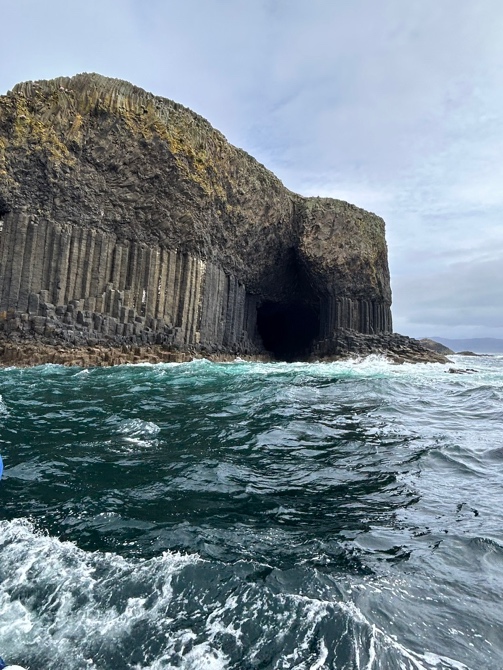
Staffa rising from the sea, as if it was the beginning of creation.
I’d heard much about Stratta, a small uninhabited island a 45-minute boat ride from Iona. One friend who had visited last fall encouraged me to make the trip to see the caves and the Puffins. I signed up for a morning tour. Nothing could have prepared me for this adventure. It was raining, cold, and windy as we boarded the boat, and we heard we might not be able to transfer to the island because of high waves. The seas were rough for most of the outward trip. En route, we spotted 4 seals sunning on a rock – a wonderful sight to see.
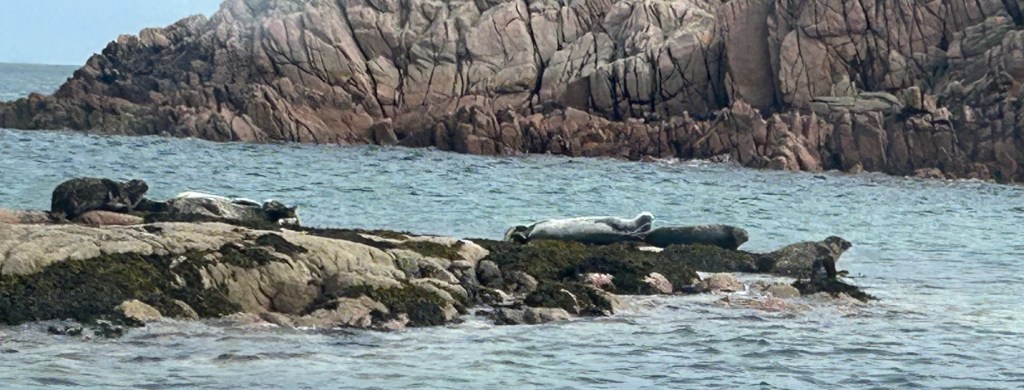
Four seals sunning on a rock.
A few minutes later, we caught sight of Staffa, rising straight up from the water. Staffa is the result of an ancient volcano, whose lava froze as it hit the water. Staffa’s sides reminded me a bit of a giant chocolate cupcake, held up by the ridges of cupcake paper, with a muffin top and two dark caves opening onto the water. There are no beaches, only intimidating rocks rising vertically from the water with two caves that look like deep, gaping holes at water’s edge. The only way onto Staffa is via boat to a very narrow dock anchored into the rock face. Our captain announced that the seas had calmed enough for us to disembark. He described the only two places we could access. The first was Fingal’s Cave – the larger of the two we’d seen. We could walk along a narrow, wet, rocky ledge, while holding onto a metal cable. Once we got to the larger cave’s opening, we could take a few steps around the opening to see the interior of the cave. The second option was to climb the narrow, wet metal stairs, with ropes on either side as handrails, to reach the top of the island. From there, a worn path led us about ¾ of a mile to the east, where there is a natural overlook to see the flocks of puffins that nest in ledges in the rock face. The captain made it clear that the ship would be back in one hour, and we would be left behind if we were late.
I could feel my anxiety rising as I looked at the waves lapping over the rocky ledge that was the way to Fingal’s Cave, felt the wind blowing, and then, as we came around a curve, spotted the steep metal staircase bolted into the rocks with only a rope to hold onto to get to the Puffin path. I confess that both options sounded awesome and intimidating. I could feel myself starting to tremble. All of us pilgrims had been encouraged to purchase insurance that would cover medical emergencies, including funds to airlift us from remote places to hospitals on the mainland. I had the insurance, but sure didn’t want to use it. Sometime between the ages of 50 and 73, I’ve become afraid of falls. Go figure. This would not be a good place to get injured, and anxiety wouldn’t help. I think I’ve matured. I remembered Shakespeare’s words spoken by Sir John Falstaff: “Discretion is better than valor.” I chose the less dangerous path to see the puffins.
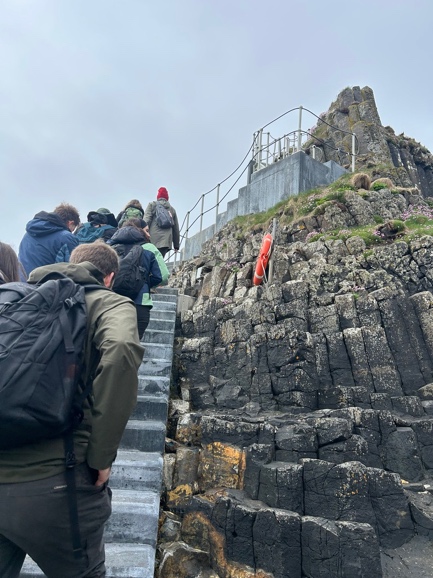
Stairway to the top of Staffa
I am happy to report that I survived the adventure without hurting myself. At the same time, I am surprised and a bit embarrassed by fear. By the time I got to the Puffin cliffs, I had been calmed by the beautiful landscape and delighted to see hundreds of Puffins, soaring, diving, and floating on the water. I remembered that Jesus had this to say about birds: “What is the price of two sparrows—one copper coin? But not a single sparrow can fall to the ground without God knowing it.” Matthew 10;29 NLT
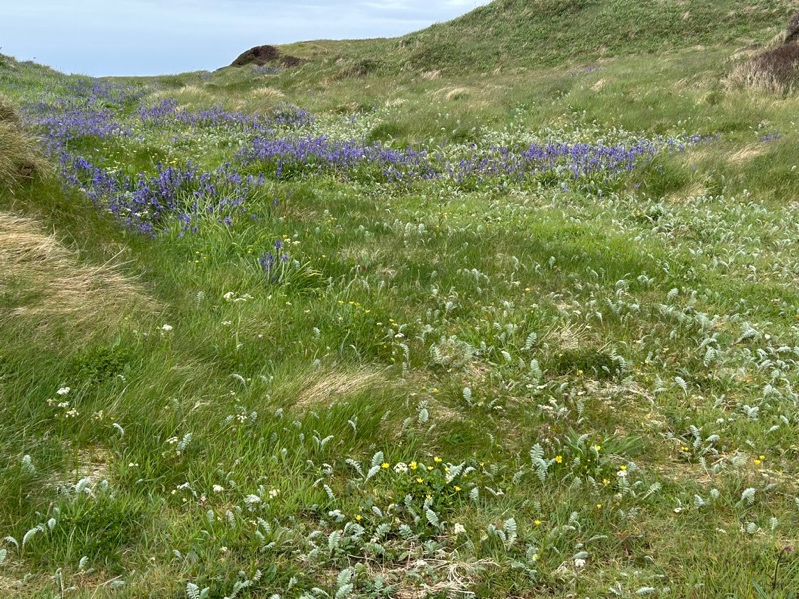
The beautiful landscape
Theologian Rudolf Otto described the numinous human encounter with the divine as having two poles: Mysterium Tremendum (the overwhelming sense of God’s absolute power, holiness, and otherness) and Mysterium Fascinans (a compelling, desirable, and comforting sense of God’s presence).
On Staffa, I experienced the Mysterium Tremendum as I beheld the wildness of the place, and the Mysterium Fascinans as I beheld the heather, the Puffins, and the green grass.
About 197 years ago, Felix Mendelssohn traveled to England and Scotland. On a voyage to the Hebrides Islands off the western coast of Scotland, he visited Staffa Island. He walked into the depths of Fingal’s Cave and reported that when he heard the wind and waves echoing from the walls of the cave, his experience prompted him to write The Lonely Isle Overture, later renamed both the Hebrides Overture and/or Fingal’s Cave. Here is a link to a very short version of the Overture, for your viewing and listening pleasure. I hope you can sense both aspects of encounters with the Holy One.
Mendelssohn’s Hebrides Overture –
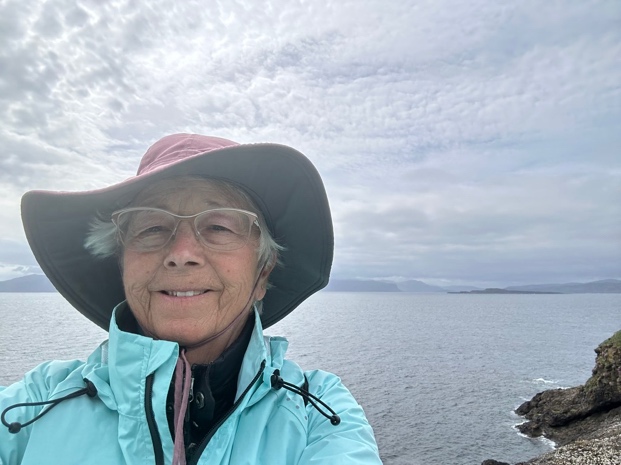
From the top of Staffa. ~ Anne
 Wayfinding