
August 22, 2026
“Get thee to a nunnery!’ We pilgrims walked past the picturesque nunnery at least twice a day while we were in Iona. We could see the remains of walls and windows, with plants growing out of stone crevices. But this time, we were there to hear the story behind the stones.
St. Columba established Iona’s original monastery shortly after he arrived in 563 C.E. Following a series of Viking raids on Iona, in 1114 C.E., the king of Norway seized it. Fast forward to 1203. Clan MacDonald, now in control of Iona, made it their ecclesiastical capital. They invited a Benedictine order to build a new monastery and an Augustinian order to build the Nunnery.
The Iona Monastery and the Abbey church have been renovated and restored several times. It is immediately obvious that all the energy and financial resources for renovation have focused on the Abbey. Iona’s Nunnery, one of three remaining in Scotland, has been left to nature. Women who had not found a marriage match, or had been widowed, were able to find financial stability in the community at a time that was not friendly to women. Its ruins are a powerful metaphor for much of women’s lives through the ages.
We were invited to imagine what life in the nunnery was like when the walls were intact and the roof protected from the elements. Remains include a kitchen area, sleeping spaces, a place for worship, what was likely an infirmary, a cloister, and areas used for gardens. A few gravestones also remain just beyond the walls.
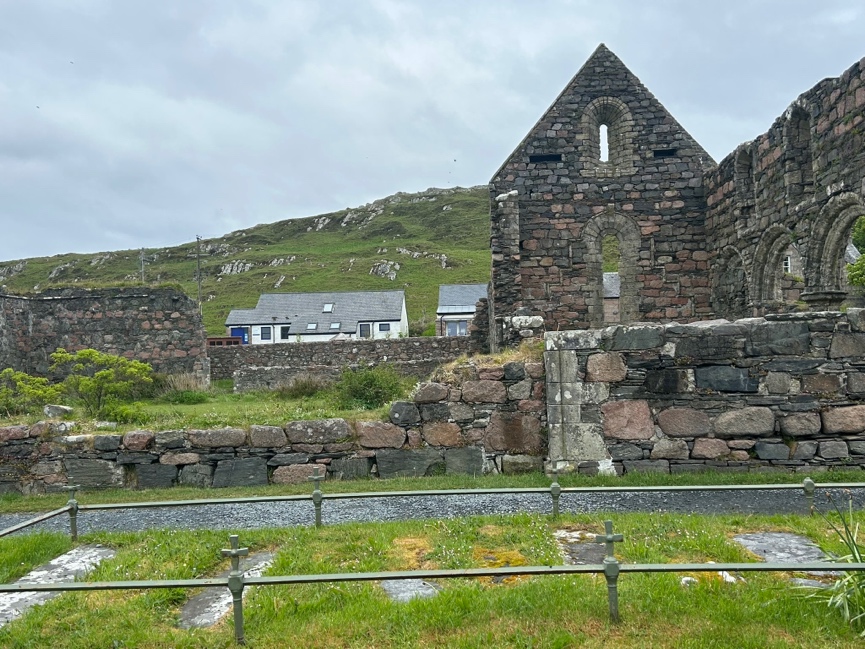
Nunnery with gravestones in the foreground
One surprising feature is a window frame that, from the exterior, seems rather ordinary, but from the interior is an ancient stone carving of a Sheela Na Gig – a pre-Christian image representative of woman as Mother, Crone, and Maiden, displaying her pelvic region. Most likely, she was placed there to ward off evil spirits and protect openings. I was reminded of old wives’ tales and practices that my grandmother took seriously. If she spilled salt, she would toss a pinch over her left shoulder. A black cat crossing your path was bad luck. Breaking a mirror means seven years of bad luck.
I always made sure my field hockey cleats’ laces were tied in the same order before games. I had a teammate – a goalie at Penn State who had a shutout in the first game of the season and didn’t wash her game socks for the remainder of the season. We did what we could to do our best. Perhaps for women then and now, such folk tales provide a sense of efficacy and choice in challenging times. Left to the elements of earth, wind and sea, perhaps the women are free.

Sheela Na Gig from outside
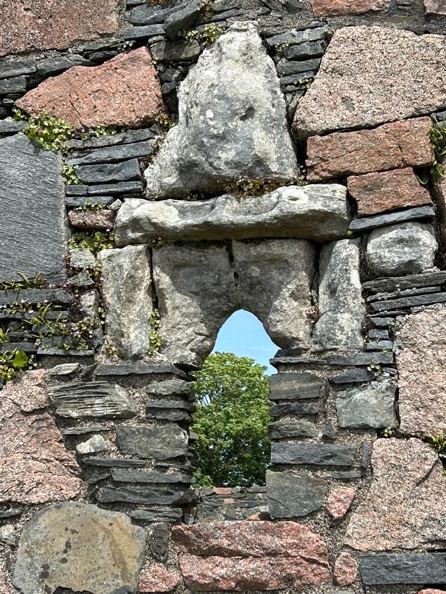
Sheela Na Gig from inside
The Nunnery’s openness to the elements gave me a sense of expansiveness and freedom, like Sheela Na Gig whose stones survived and supported the window that looks to the West, where the Wild Goose (the Celtic image of the Holy Spirit) flies free in this windswept wild place. ~ Anne
P.S. These are Hamlet’s words when he was at the end of his wits with Ophelia, a young woman with whom he was having a relationship, taken from Shakespeare’s Hamlet. Old traditions indicate that the real King Hamlet was buried near Iona Abbey.
“If thou dost marry, I’ll give thee this plague for thy dowry. Be thou as chaste as ice, as pure as snow, thou shalt not escape calumny. Get thee to a nunnery, go. Farewell. Or, if thou wilt needs marry, marry a fool, for wise men know well enough what monsters you make of them. To a nunnery, go, and quickly too. Farewell.” Spoken by Hamlet, who expected to be made king, at his wits’ end, to Ophelia, a young woman with whom he is having a relationship.

