July 21, 2024
‘Jesus was tired from his journey, so he sat down at the well. It was about noon. A Samaritan woman came to the well to draw water. Jesus said to her, “Give me some water to drink.”’ ~ John 4:6-7 NRSV
I had the privilege of spending July 1 – July 3, 2024, with 7 youth and 5 adults on a Mission Trip at a Heifer International Global Village at Shepherd’s Springs Camp in Maryland. For three days we were immersed in learning about and experiencing how poverty impacts persons around the world. One of the first lessons we learned was how resources needed for survival are not distributed evenly around the globe. As an example, North America has 13% of the world’s population and a proportionately much large percentage of the world’s natural resources. And one of those resources is water.
We learned, for example, that in Mozambique, the typical household is only able to access about 5 gallons of water per day. In North America, one flush of a toilet sends 2.5 gallons of drinkable water down the drain. We also learned that much of the world’s population has to walk a significant distance to get water. A school girl in Mozambique needs to wake up before sunrise to get dressed and ready for the day and make a 3-mile round trip hike to the closest water source to collect 5 gallons of water which the family will need to use for cooking, cleaning, and feeding animals.
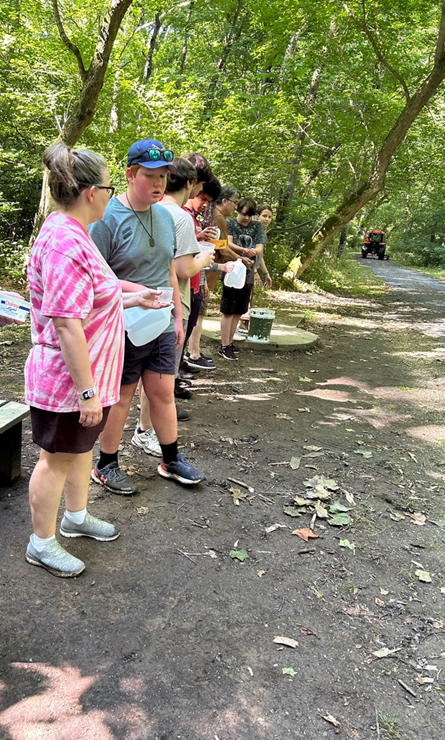
We were invited to participate in a water hike, far less than 1.5 miles, but nonetheless up and down hill and over a muddy stream to a well. There were a variety of containers for ten of us to use. These included two one-gallon plastic bottles, empty margarine containers, and even one tiny plastic container that had once held a single serving of yogurt. Two us of us needed to use our cupped hands to collect the water. Getting to the well was not challenging. But when we got to the well we discovered a big problem. We needed to pass the water from the front of the line to the end of the line so that everyone had a full container before we could return to the village.
How would you have organized that?
After several trials, we realized that we needed the people with the biggest containers to be first in line to pass the water on to smaller containers. Once everyone’s container was filled, we had to hike back to the village, trying not to spill any water. I slipped in mud and lost some of my precious cargo. Another person tripped and lost all his water. One of the gallon containers had a leak. By the time we got to the village we had less than 2 gallons left. Imagine what that would be like in real life, with dangers along the way from animals as well as armed enemies.
I realized how I take easy access to clean water for granted. I am often only steps away from a faucet. We were challenged to make small changes to help preserve this precious resource such as only washing a full load of clothes, leaving a jug of drinking water in the refrigerator rather than ran the water at the faucet until it gets cold, turning the water off while brushing our teeth, and taking shorter showers. I’m turning the faucet off when brushing my teeth as one way to begin to conserve.
The story of Jesus and the woman at the well has taken on new meaning. Jesus didn’t have a bucket to draw the water, he needed to rely on the woman. And the woman took the time to draw the water with her own bucket to give him a drink. Fresh and safe water can be the difference between life and death. I am grateful that the one who is the Living Water was given a drink by that lone, courageous woman. What she got from sharing was eternal. ~ Anne
Water Line
 Wayfinding